
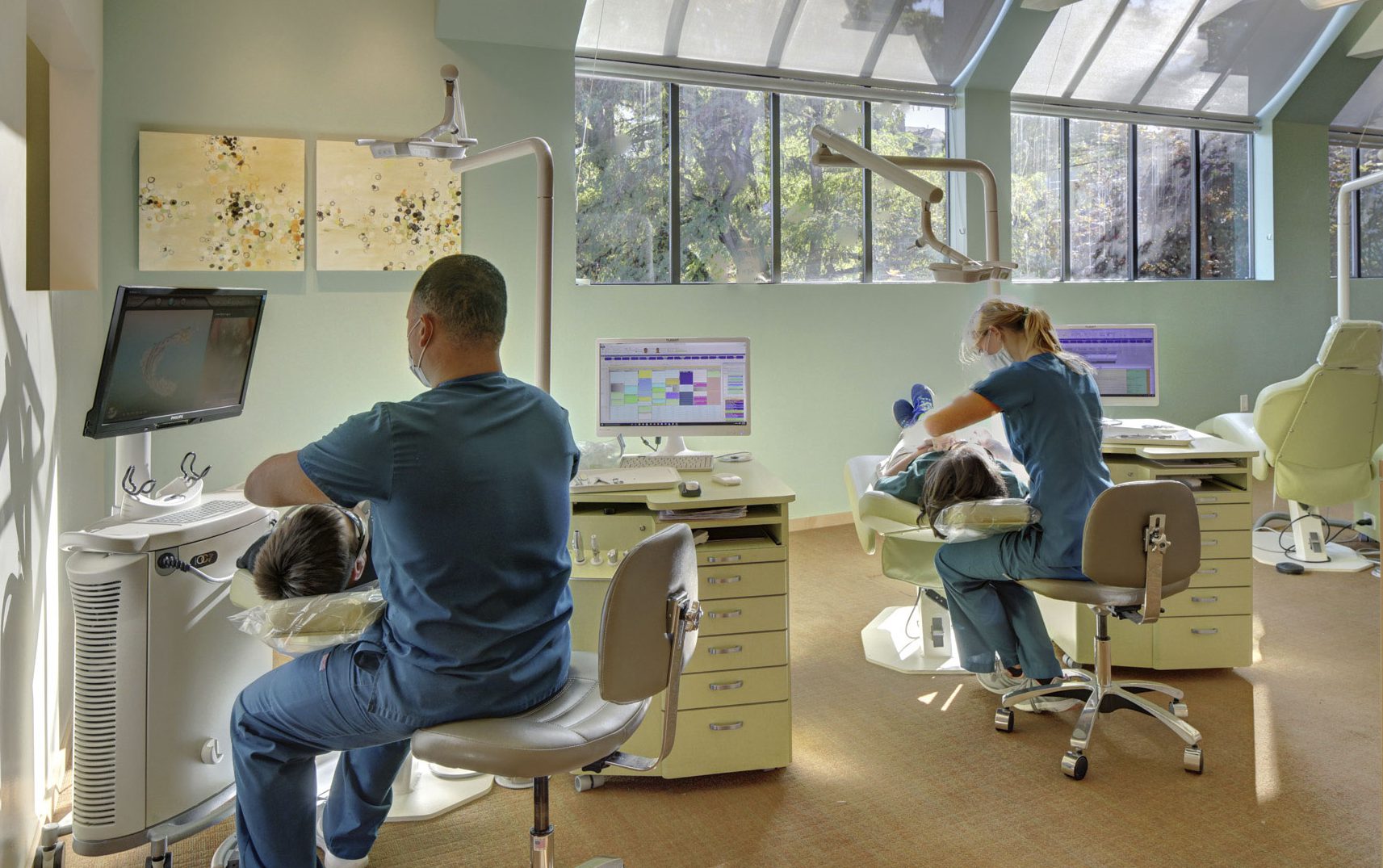
Invisalign for Children
Your Questions Answered
Can Children Be Treated with Invisalign Aligners?
Yes. Children who are receptive to parental supervision and whose required tooth movements can be efficiently accomplished using aligners are excellent candidates for aligner treatment with an orthodontist. (See “How an Orthodontist Differs from a Dentist.”)
Aligners, for children and adults, are orthodontic appliances, like braces, for use by specialists in orthodontics. They are clear plastic “trays” that fit snuggly against the teeth when inserted as instructed, with each aligner in sequence moving the teeth to that aligner’s pre-formed position.
Importantly, they are produced according to the orthodontist’s customized treatment plan and are further modified by the orthodontist as required using segmentation and other methods.
Should I take my child to an orthodontist for treatment with Invisalign?
The short and informed answer is yes.
The success of treatment with aligners is dependent upon the expertise of the practitioner, including specialized, post-doctorate education and training in evaluation of the changing face over time and the implications for treatment planning and outcomes (orthodontics & dentofacial orthopedics).
Expertise in orthodontics is required to properly diagnose and plan treatments, including how and where teeth should be placed in the bone now for aesthetics and stability consistent with growth and over the lifetime. In addition, only an orthodontist can accurately assess if aligners are an appropriate tool for the required movements and how to accomplish those movements safely. (See How an Orthodontist Differs from a Dentist)
It is important to understand that Invisalign and other aligner brands are not comprehensive, plug and play, treatments.
The limited software associated with aligners and used by general dentists provides a baseline analysis only and requires extensive modification in over 95% of cases, even for adult treatment. Discerning the need for modification, and the ability to make those modifications, including to the aligners themselves, are not in a general dentist’s skill set.
Software does not account for facial form, growth patterns, age, familial tendencies, movement obstacles, or individual variances of any kind, all of which are weighed by the orthodontist when determining the correct, customized treatment plan and modality.
Orthodontists see MANY failed “Invisalign” cases in their offices that have been attempted by general dentists, who have neither specialist post-doctorate degrees nor residencies in the alignment of teeth and jaws.
While general dentists and paedodontists (pediatric dentists) do not have the knowledge to correctly diagnosis, plan, and treat orthodontic cases, they perform critical dental-health services and static cosmetic work.
Your general dentist and orthodontist work as a team to provide excellent care for your child.
How Do I Know if My Child Needs Orthodontics?
Common symptoms that may require orthodontic intervention:
- Crowded or overlapping teeth
- Gaps between teeth
- Congenitally missing teeth
- Bite (occlusal) issues, such as
- over jet (upper central incisors projecting out beyond lower incisors)
- under jet (lower incisors in front of upper incisors when closing teeth)
- deep bite (excessive vertical overlap of upper and lower incisors)
- cross bite (lower molars further away from the tongue than upper molars)
- Difficulty chewing or speaking due to bite issues or tongue and teeth relationship
Note: The severity and requirement for treatment of the above conditions can only be accurately assessed by an orthodontist, who is trained to assess skeletal and soft tissue relationships in the growing child to determine what, if any, action should be taken.
Fortunately, most orthodontists provide complimentary initial examinations during which you will learn if and, if so, when your child requires treatment.
When Should I Take My Child for Evaluation by an Orthodontist?
Initial examinations are recommended by the age of seven due to developmental windows that can be missed. There are skeletal developmental stages during which orthodontic treatment is more easily accomplished.
Also, there are orthodontic issues that, if addressed early, can eliminate more extensive treatment that would otherwise be required at a later developmental stage when treatment becomes more complex.
Early intervention with interceptive treatment is sometimes necessary to assist in creating a favorable relationship between the bones and teeth. Orthodontists evaluate the need for interceptive, “stage one,” treatment during your child’s initial consultation and will inform you if treatment, whether stage one or comprehensive (stage two) will be needed.
If treatment will be required but at a later date, complimentary “recall” appointments are scheduled to periodically assess development, allowing treatment to begin at the most opportune time.
Early diagnosis and treatment assist your child due to the relative pliability of hard and soft tissues during growth and the greater ability to influence underlying structures, making treatment more straightforward.
If your child is older than seven, however, treatment will still be successful. Orthodontics works at every age.
Why Consider Aligner Treatment for My Child?
Advantages of Aligners
The use of aligners for younger children, who are typically more responsive to adult supervision, is, in most cases, a superior treatment method because it is both less invasive than braces and produces less resistance within the patient.
For the reasons above, young children, ages 6-12, are often ideal candidates; they are highly compliant, exhibiting consistent aligner wear, and, therefore, achieve successful outcomes in an appropriate period of time.
In addition, aligners are:
More comfortable than braces
Nearly invisible
Removable for short periods for eating and hygiene
What is Involved in Invisalign Aligner Treatment for My Child?
Consistent aligner wear is very important for successful treatment. Fortunately, once your child learns how to “seat” the aligner over his or her teeth and becomes accustomed to wearing the aligners at all times except when eating or drinking, aligner wear becomes habitual. Children who are willing to follow instructions and are responsive to your guidance make excellent patients!
When teeth are moved, ligaments are stretched. Consequently, when aligners are taken out, ligaments contract, pulling the teeth back quickly. Unfortunately, this reversal is not symmetric across teeth. If an aligner is removed for more than two total hours per day, the teeth will revert in a haphazard way, preventing the previous aligner from fitting. One cannot simply go back to the previous aligner. This is why regular wear of 22-hours per day is needed. Aligners are removed for eating and hygiene only.
Each new aligner will feel tight and does cause temporary discomfort. Typically, this discomfort is less severe than that experienced in braces, which points to the fact that aligners are a bit slower acting: they cannot make the sweeping movements of braces, rather, they work gradually, with each new aligner only slightly different from the last. A benefit is that this reduces the initial discomfort of each aligner.
How Long Will Treatment with Aligners Last?
Treatment times vary depending upon the complexity of tooth movements and skeletal factors. Most treatments are completed within 18 months, with some of shorter duration. A minority of treatments take longer than 18 months, but treatment with aligners is dependent upon wear, which affects treatment length. Consistent, 22-hour-per-day wear is needed for effective and efficient treatment.
How Does the Cost of Aligner Treatment Compare to Braces?
The cost of treatment with Invisalign aligners is comparable to that with precision braces. Typically, a cost differential between the two appliances is not the deciding factor for parents.
Factors determining treatment cost are those that influence treatment complexity and length, which you will learn during your complimentary consultation. Any estimate without an examination would be inaccurate. This is one reason why orthodontists typically provide a free initial consultation.
You will leave your complimentary consultation knowing a comprehensive price and will be presented with payment options, including a payment slider, which you may use to choose an individualized monthly payment.
Another factor that influences overall cost is the patient’s willingness or ability to wear the aligners as required. Additional Invisalign costs may be accrued if aligner wear is inconsistent or disrupted, resulting in the need for a new treatment plan and set of aligners.
Treatment with Invisalign aligners by an orthodontist, like braces, is covered under orthodontic insurance plans.
Is Treatment with Invisalign Aligners as Effective as Braces?
In most instances yes, however, in practice, the effectiveness of aligner treatment is dependent upon three factors:
- The quality of the diagnosis and aligner treatment plan, and the ability of your orthodontist to overcome the mechanical limitations of aligners
- The mechanical appropriateness of aligners for the movements that must be made (aligners can push but not pull, whereas fixed appliances such as braces move in a sweeping arc and in multiple directions)
- The willingness of your child to wear the aligners at least 22 hours per day necessitated by the rapid regression brought about by contracting ligaments
Are Aligners Safe for Children?
Yes. Because aligners are pliable, they are very difficult to break and are not cracked during chewing. Your child will not swallow pieces from the aligner.
We advise all patients treated using aligners to avoid hot food and beverages when the aligners are in place because the aligners are affected by high heat. Otherwise, there is no cause for concern with aligner use.
Why Should I Choose Dr. Wong for my Child’s Invisalign Aligner Treatment?
A Few Highlights About Keith B. Wong, DDS, MS
Dr. Wong
- has successfully completed over 8,000 orthodontic treatments using a variety of orthodontic appliances, including Invisalign aligners, precision braces, and other advanced treatment tools.
- is an expert in the science of tooth movement and dentofacial orthopedics and a Diamond Plus Invisalign provider who uses his extensive knowledge to accurately diagnose your child’s needs and specify your child’s aligner treatment from the first to last aligner to arrive at the most stable and aesthetically pleasing bite and smile over the lifetime.
- evaluates not only your child’s teeth but also the soft and hard tissues of the face to determine the most pleasing and stable orthodontic position and, importantly, the efficient and effective means to reach that goal. Not all appliances are appropriate for all cases. Determining the route is as important as determining the destination.
- is recognized by his peers for excellence in diagnosis, treatment planning, and execution, using both aligners and fixed appliances, for the growing child and adult.
- recently participated in a 15-person roundtable of leading North American orthodontists during which he presented novel aligner modification techniques that allow him to complete movements that could otherwise only be accomplished with braces.
- loves his profession and is committed to excellent results for his patients, consistently working 70+ hours per week, with over half of that time spent outside of clinic hours pursuing diagnosis and treatment-planning.
- is laid back, very comfortable with children, and places children at ease.
- is, to top it off, just a very nice guy!
If you have more questions about Dr. Wong, what to expect at your consultation, or Invisalign aligner treatment with an orthodontist, please telephone our office or peruse our website for additional information. If you would like to explore Invisalign aligner treatment for your child with Dr. Wong, contact us or schedule your initial consultation using our online consultation scheduler through the buttons below. We will be happy to assist you!